Agriturismo in Umbria with Educational Farm, Cooking Classes

4 Results list

Map Save search Favourites
Featured
Montone (Perugia)

Agriturismo I Due Mondi

From €135 per night up to 3 guests

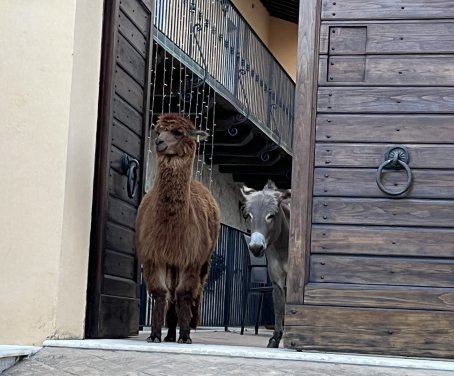
The "I Due Mondi" agritourism and educational farm is located in upper Umbria near the wonderful medieval town of Montone, in a strategic position just…

Outdoor poolRestaurant Educational FarmPets welcome14 bedsApartmentsCountrysideFree Wi-FiAir conditioningDisabled access2 Offers found
4.9 Excellent 3 reviews More information

Featured
Spoleto (Perugia)

Agriturismo Borgo Incantato Spoleto

From €200 per night for 2 guests

At Borgo, a convent of 13th Century located in the Woods where century history joins the breathtaking beauty of Nature that leaves one amazed and intrigued…

Outdoor poolSpaRestaurant Pets welcomeEducational Farm50 bedsRoomsHillFree Wi-FiDisabled access
4.9 Excellent 3 reviews More information


Orvieto (Terni)

Agriturismo Lapone

From €150 per night for 2 guests

Lapone is surrounded by vineyards and olive groves. Our Apartments and most of the rooms overlook the lovely square.

Outdoor poolRestaurant Educational FarmPets welcome15 bedsApartments, RoomsCountrysideFree Wi-FiAir conditioningDisabled access
4.6 Excellent 3 reviews More information

How we rank properties


Agriturismo in Umbria with Educational Farm, Cooking Classes

Farm stays in Umbria occupy the one Italian region with no coastline at all — hills, oak woods and river valleys instead, which is how it earned the name "the green heart of Italy". Farms here are typically smaller and less commercial than in neighbouring Tuscany, and prices tend to follow.

Where to base yourself

The area around Assisi and Spello puts you within reach of the region's best-known churches and hill towns, with Perugia half an hour away. Further south, the Valnerina cuts a narrow wooded valley towards Norcia, known for its pork butchery and its lentils, and continues to the Marmore waterfall. Around Lake Trasimeno the land flattens and warms, with swimming, cycling and island ferries. In the far south, Orvieto sits on its volcanic rock above vineyards producing the white wine that carries the town's name.

What to expect on the farm

  • Olive oil from Trevi, Spoleto and the Assisi slopes, among the most respected in Italy
  • Truffle hunts with a dog and handler, black truffle in summer and winter, white in autumn
  • Farmhouses restored in local stone, often with only a handful of rooms
  • Half board at farms with their own kitchen, which is common here and worth taking
  • Horse riding and marked walking trails, including stretches of the Way of St Francis

Practical notes

Spring brings the wildflower bloom on the Castelluccio plateau, usually late May to early July, and it is the single busiest window in the region. Autumn is quieter and better for food: truffle, new oil and chestnuts arrive together from October. Winters are cold inland and many farms close between January and March.

Perugia has a small airport; most visitors arrive via Rome, roughly two hours by car, or Florence. Trains reach Assisi, Spoleto and Orvieto, but a car is needed to get from any station to a farm in the hills.

In Umbria we have 325 farmhouses, including 268 with swimming pool, 121 with restaurant and 197 pet-friendly.


The best educational-farm agritourism stays: animals, garden, workshops and nature for children and families, with locally sourced produce and guided activities.
Are you an owner?
List your property on Agriturismi.it
Find out how

Where to find a farm stay in Umbria: provinces and valleys

From Lake Trasimeno and the Valle Umbra to the wooded Valnerina and Orvieto hills.

Perugia, Assisi & the Umbrian Valley

Stone farmhouses around Perugia, Assisi, Spello, Trevi and Spoleto sit along steep olive-growing slopes and the wine ridge connecting Torgiano and Montefalco.

Lake Trasimeno & Upper Tiber Valley

North-west of Perugia, gentle shores offer lakeside swimming and cycling routes, while oak woods around Gubbio and Città di Castello are prime truffle country.

Todi & Colli Martani

Small family-run holdings in central Umbria combine arable fields, vineyards and olive groves between hill towns overlooking the middle Tiber valley.

Southern Umbria pairs volcanic-soil vineyards around Orvieto with the wooded gorges of the Nera river valley, Norcia and trails leading into the Sibillini Mountains.

Practical planning tips

  • Getting around: Regional trains serve Perugia, Assisi, Spoleto, Terni and Orvieto, yet a car is necessary to reach rural farmhouses and explore smaller hilltop towns.
  • Seasonal calendar: May–June brings mild walking weather and the Castelluccio wildflower bloom (late May to early July); autumn from October onwards focuses on olive pressing and truffles.

Protected foods, DOCG and DOC wines

Signature certified products include Umbria DOP extra virgin olive oil (five geographical subzones), Lenticchia di Castelluccio di Norcia IGP, Farro di Monteleone di Spoleto DOP, Prosciutto di Norcia IGP, Patata Rossa di Colfiorito IGP, Pampepato di Terni IGP and Vitellone Bianco dell'Appennino Centrale IGP. Leading appellations are Montefalco Sagrantino DOCG and Torgiano Rosso Riserva DOCG alongside Orvieto DOC, Montefalco DOC, Colli del Trasimeno DOC, Assisi DOC, Spoleto DOC and Todi DOC.

Frequently asked questions about Umbria

How many agriturismi are there in Umbria and how are they distributed?
There are 325 active agriturismi in Umbria. The province with the highest concentration is Perugia, with 261 structures, followed by Terni with 64. The offerings span very different territories: from the hills of Trasimeno to the Apennine valleys in the south.
Which areas of Umbria are best for an agriturismo stay?
The areas with the highest concentration of structures and established demand are Lago Trasimeno, with its lakeside landscapes and olive groves; Valnerina and Marmore, suited to those looking for nature and river trails; and Gubbio and its surroundings, a zone of woodland and truffle. Todi offers hills planted with vines and olive trees. Cascia is the main reference point for Umbria's high mountain terrain and the Parco dei Monti Sibillini.
What are the typical products and cuisine of Umbrian agriturismi?
Umbrian cuisine is built around minimally processed ingredients: Castelluccio IGP lentils, spelt, fagiolina beans from Trasimeno, black truffle from Norcia and white truffle from Gubbio. Cured meats — norcineria in particular — appear on nearly every menu. The main wines are Sagrantino di Montefalco DOCG and Torgiano Rosso Riserva DOCG. DOP Umbria extra virgin olive oil is produced throughout the region.
What is the best time of year to visit an agriturismo in Umbria?
Spring (April–May) is well suited for hiking and wildflower season; autumn (October–November) coincides with the olive harvest, the white truffle season, and local food festivals in the borghi. Summer is hot and crowded around Trasimeno. Winter suits those looking for quiet and lower rates, with possible snowfall in the Apennines from December through February.
What services do agriturismi in Umbria offer?
Services vary considerably from one property to another. The most common service is a swimming pool, found at more than four properties in five, followed by pet-friendly accommodation and an in-house restaurant, offered by more than one in three. Some properties have a fattoria didattica or organic certification. On Agriturismi.it you can filter structures by individual service to find the ones that match your specific needs.
What can you do during an agriturismo stay in Umbria?
The most popular activities include wine and olive oil tastings on the estate, hiking or cycling along the CAI trail network, and day trips to nearby art cities (Assisi, Spoleto, Orvieto). In the Valnerina and Marmore area, outdoor activities such as rafting and canyoning are widely available. Truffle hunting with trained dogs is a common experience, especially in the area between Norcia and Gubbio.

SUBSCRIBE TO THE AGRITURISMI.IT NEWSLETTER

Exclusive deals, travel ideas and rural lifestyle news